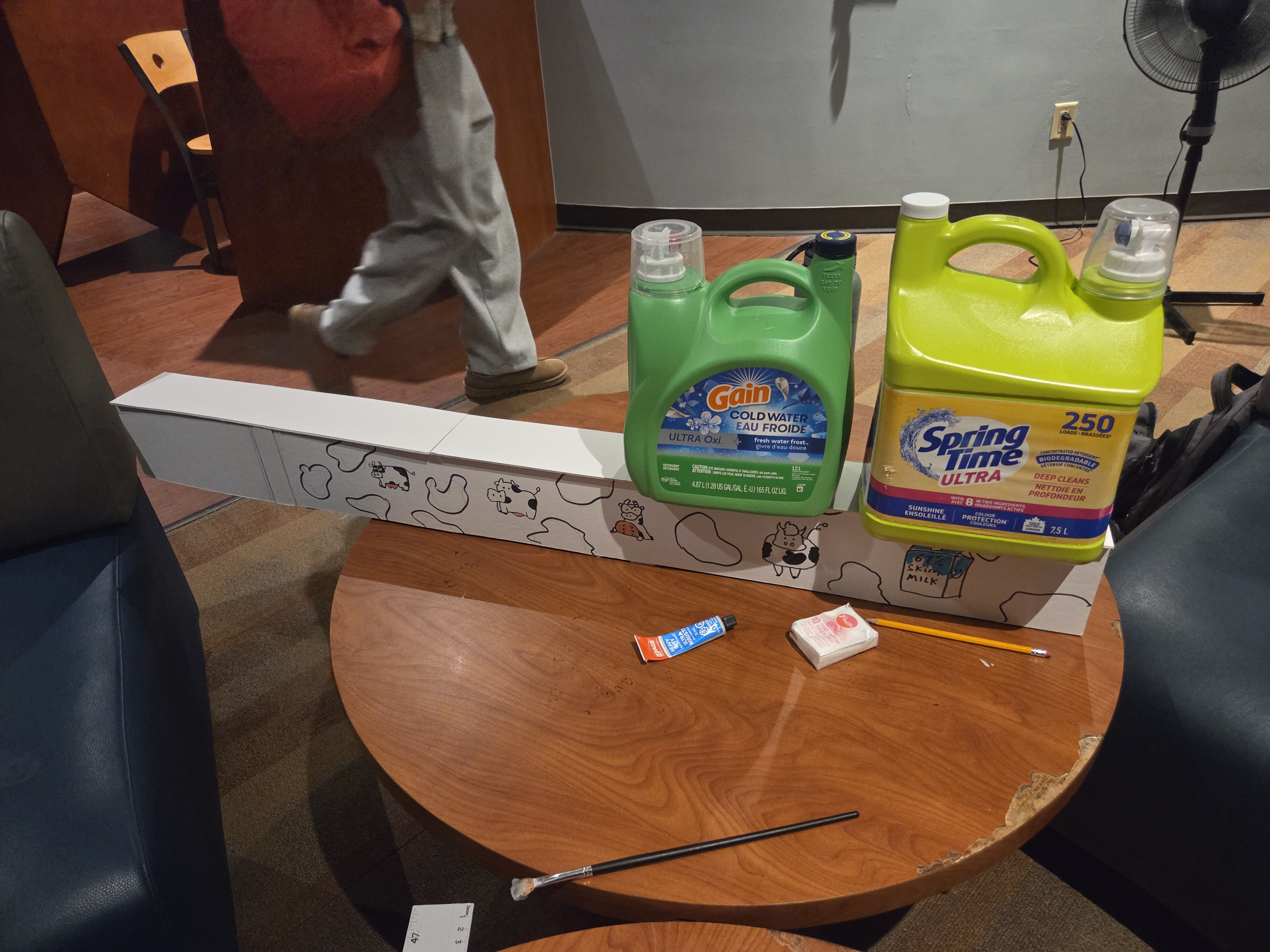
In CIV102, we were tasked with designing and constructing a bridge entirely out of 1.27mm thick matboard and contact cement. The structure needed to span a specified gap and withstand a dynamic, moving 1250 N (approx. 125 kg) train load, all while minimizing its own weight to achieve the highest possible structural efficiency.
2. The Product
We engineered an optimized Pi-section truss bridge. Before cutting a single piece of matboard, I developed a custom Python simulation engine to calculate shear force envelopes, bending moments, and localized buckling risks across the entire span, allowing us to mathematically guarantee the structure's integrity and predict its exact failure load.
3. Enacting My Position
As an Iterative Investigator, I value Accountability through rigorous empirical and mathematical proof. I believe software is a tool to elevate the quality of physical engineering. By writing a custom script to handle thousands of repetitive calculations, I demonstrated my value of Efficiency. This prevented us from blindly guessing geometries so we could focus strictly on precision during the physical construction phase.
CTMF: Requirements Framework (Frame)
Application: We utilized a strict Requirements Framework to frame our design space. By explicitly defining the 1250 N dynamic load and the strict 1.27mm material thickness limit, we successfully bounded our engineering calculations before attempting any physical modelling.
Evaluation & Reflection
Effectiveness: High. This framework enforced my values of Safety and Accountability. By establishing exactly what the bridge needed to survive, it prevented us from under-designing the cross-section or wasting material on overly redundant, heavy supports.
Future Application: I will continue using Requirements Frameworks at the very beginning of structural projects. It serves as the definitive checklist to determine if a design is mathematically viable before any resources or time are spent on prototyping.
CTMF: Detailed Design & FBDs (Represent)
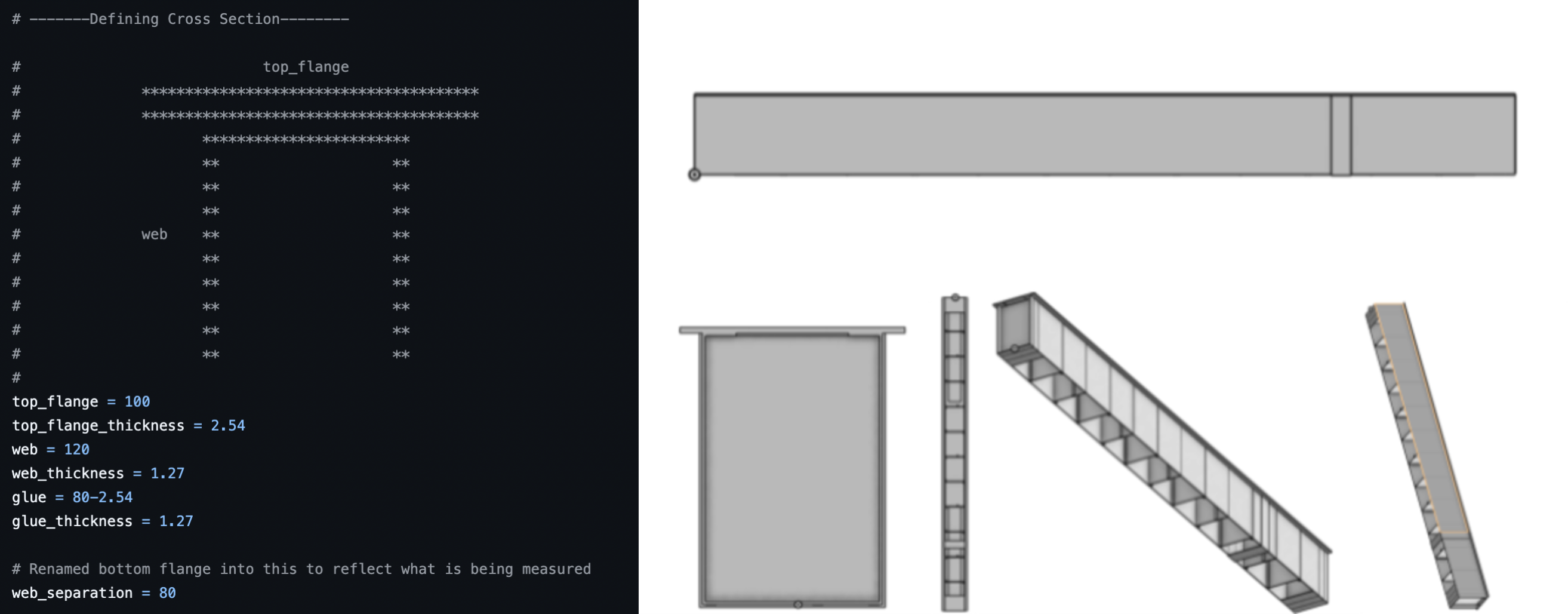
Application: Before cutting material, we relied on Detailed Design through the representation of Free Body Diagrams (FBDs) and cross-sectional CAD models. I translated these FBDs into a Python environment to mathematically simulate shear forces, bending moment envelopes, and all three forms of plate buckling under the moving train loads.
Fig 1: Custom Python script defining the cross-sectional geometry matrix (left) to simulate load distributions for the Pi-section CAD model (right).
Evaluation & Reflection
Effectiveness: Essential. We represented the FBDs programmatically to minimize the errors in our structural math and to ensure that our conclusions were data driven. This demonstrates my Accountability in avoiding the error-prone nature of hand calculations to maximize Safety.
Future Application: I will always represent complex systems using detailed mathematical models and simulations before physical execution. It is one of the most effective ways to predict unsafe failure modes before they occur in the real world.
CTMF: Spiral Model of Design (Process)
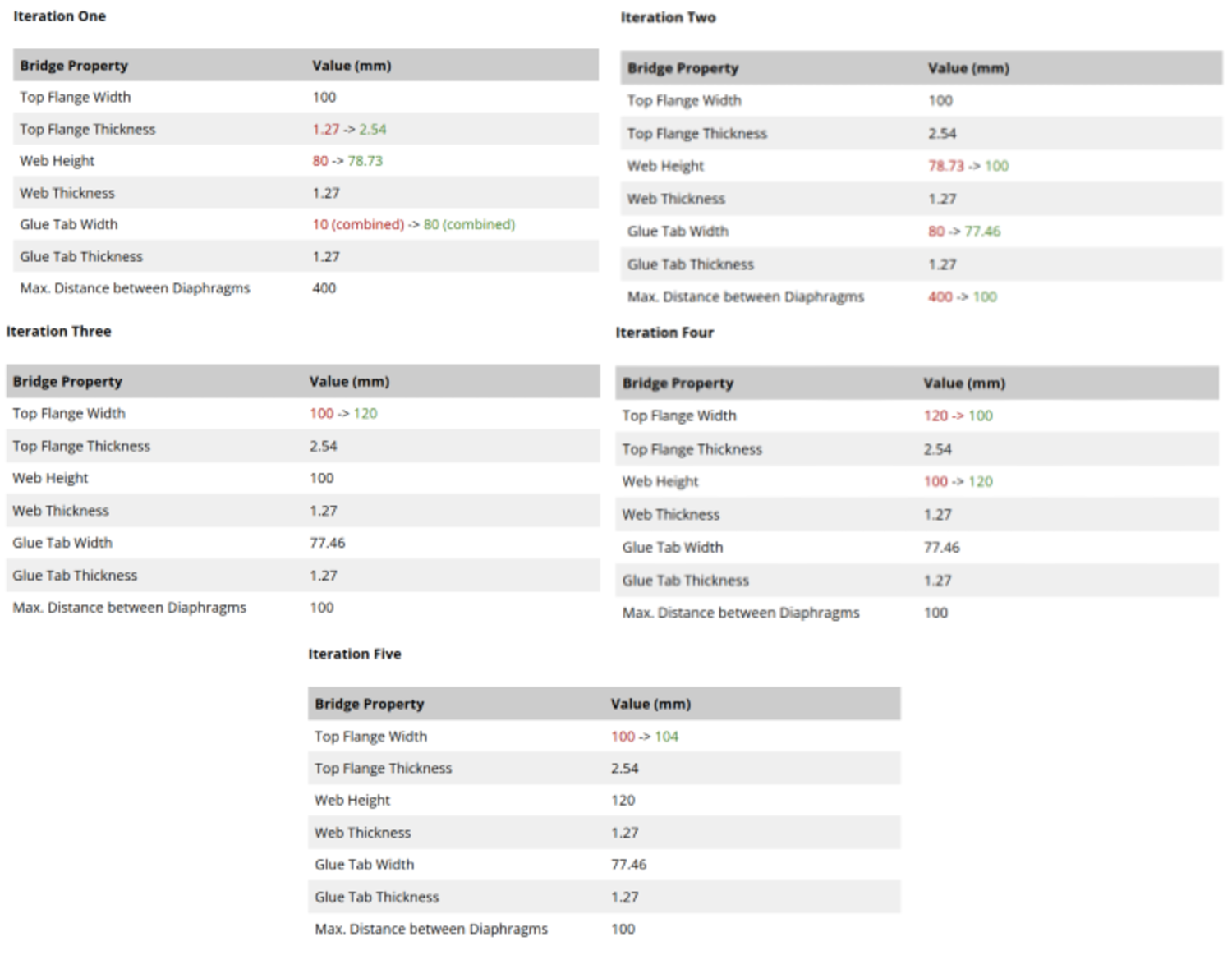
Application: Our structural optimization was driven by the Spiral Model of Design. We progressed through 5 distinct mathematical iterations in Python. With each cycle, we analyzed predicted failure points and systematically adjusted the cross-sectional geometry to maximize the load-to-mass ratio.
Evaluation & Reflection
Effectiveness: Highly Effective. Instead of building 5 physical bridges and breaking them, we decided to work with Efficiency by simulating the iterations mathematically, trading theoretical maximum strength for practical manufacturability in mere seconds.
Future Application: I will use the Spiral Model in future software and hardware integrations. Iterating in a simulated environment is drastically cheaper and faster than iterating with physical materials, and ensures the final physical build is highly optimized.
In accordance with the UofT Code of Academic Behaviour, I acknowledge the hard work of my CIV102 bridge team: Karan Chawla, Angela Jiao, and David Shoeib. The physical construction, material testing, and final load-testing procedures were executed collaboratively.
References
[1] A. Kuan and P. Collins, "CIV102: Structures and Materials Course Notes," Dept. of Civil and Mineral Engineering, University of Toronto, Fall 2025.
[2] CIV102 Matboard Bridge Design Project Requirements, University of Toronto, Fall 2025.