CTMF: NGO Framework (Frame)
Application: We utilized the Needs-Goals-Objectives (NGOs) Framework to effectively frame this opportunity. By mapping the implicit stakeholder Need (convenient hydration) to explicit Objectives (maximizing vertical clearance, minimizing splash radius), we successfully bounded the design space to focus purely on spatial fluid redirection.
Evaluation & Reflection
Effectiveness: High. This framework was critical in preventing scope creep, demonstrating my value of Efficiency. Without it, we risked getting distracted by focusing primarily on filtering or disinfecting the water, rather than redirecting it.
Future Application: I will use the NGO framework in future hardware projects specifically when a client's request is vague. It is an excellent tool for translating subjective interpretations of design ideas into bounded, testable engineering metrics.
CTMF: Morphological Charts (Diverge)
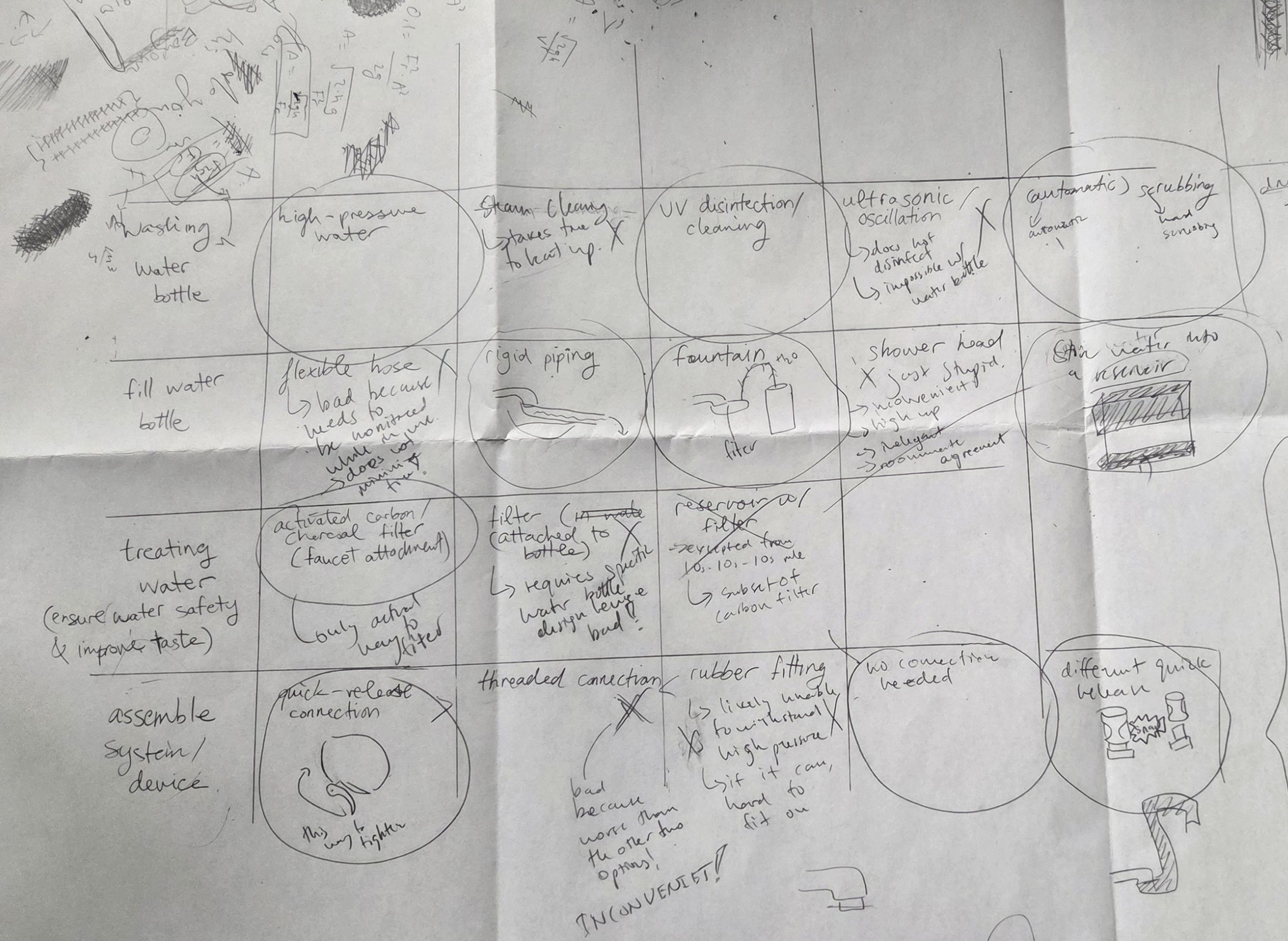
Application: To avoid cognitive fixation on a single faucet type, we utilized Morphological Charts. We broke the fluid redirection system into distinct sub-functions (attachment mechanism, material flexibility, nozzle shape) and systematically brainstormed combinations to generate candidate designs.
Evaluation & Reflection
Effectiveness: Moderately, but Risky. While Morphological Charts are excellent at forcing structural divergence, I found they actively threatened my value of Efficiency by generating dozens of unviable concepts, such as the use of a shower head or a high-pressure nozzle; both of which were impractical.
Future Application: I will only use this tool moving forward if it is immediately paired with a strict convergence tool (like a Pugh or Pairwise chart). Diverging for the sake of diverging distracts me from the practical design concepts that I come up with.
CTMF: Proxy Testing (Represent / Validate)
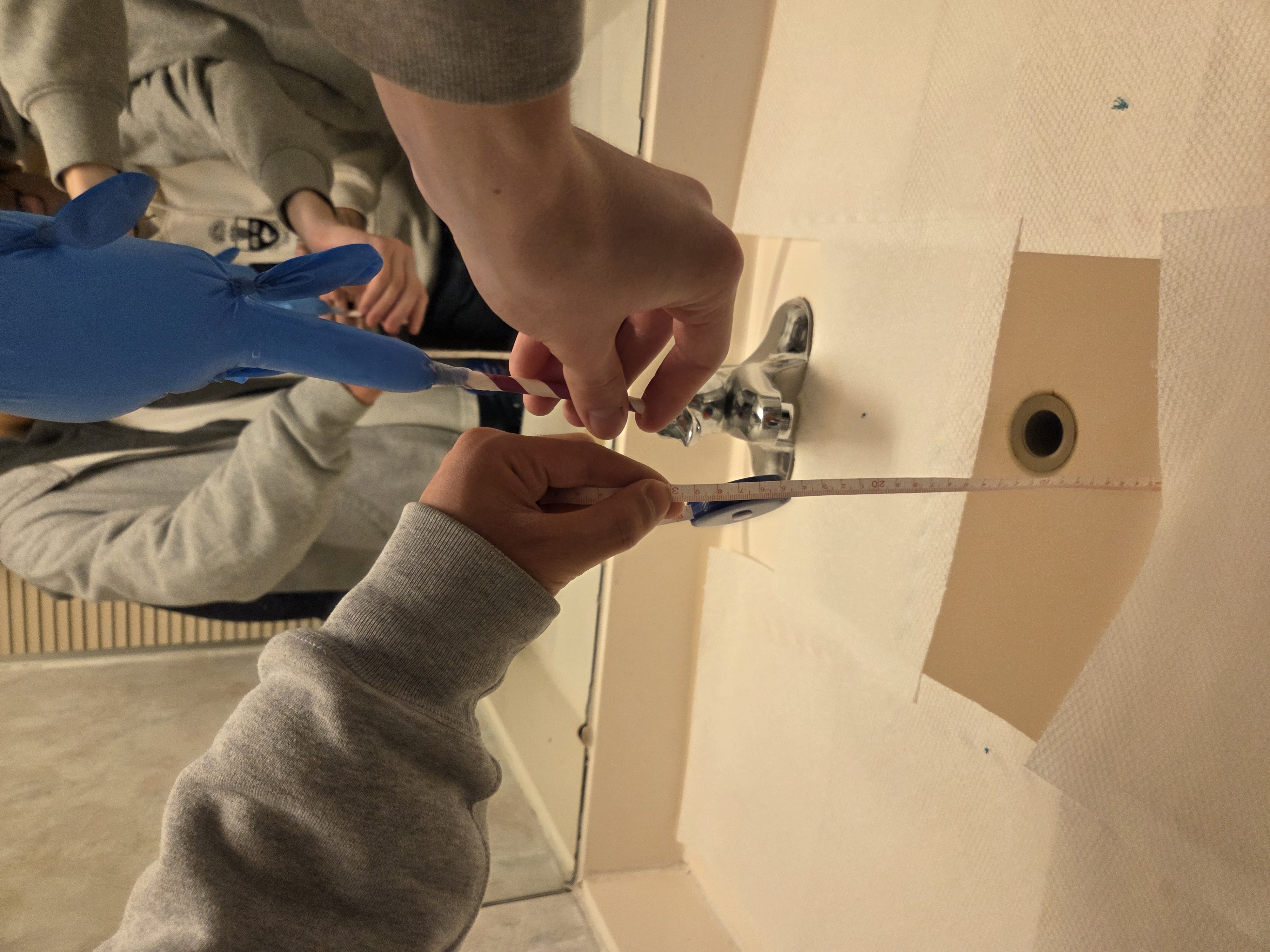
Application: Rather than relying on theoretical assumptions or subjective bias, we employed Proxy Testing to rigorously validate our divergent concepts. By constructing low-fidelity physical models, such as using a modified nitrile glove and a measuring tape to simulate fluid redirection, we generated empirical data on flow rates and splash radii directly in the Chestnut sinks.
Evaluation & Reflection
Effectiveness: Very High. This hands-on tool perfectly aligns with my value of Accountability. Theoretical math cannot account for the unpredictable variables of real-world plumbing (water pressure fluctuations, irregular faucet threading).
Future Application: Proxy testing will remain a must-do of my methodology for engineering design. Before writing complex simulations or machining final parts, running a physical proxy test provides a high return on investment for a low cost.
In accordance with the UofT Code of Academic Behaviour, I explicitly acknowledge the contributions of my Praxis I teammates: Matthew Lam, Henry Han, and Greg Paramonau. The morphological charting, proxy testing, and final design report reflect our collaborative engineering analysis.
References
- [1] Praxis I Engineering Design Studio. "Group 42 - Design Report: Rigid Pipe Attachment." University of Toronto, Fall 2025.