Community woodworking shops, such as GTA WoodWorks, discard thousands of mixed, unsorted fasteners annually because manual sorting is economically unviable and tedious. We had an engineering opportunity to design a system that could accurately sort mixed screws quickly and reliably enough to be adopted by the workshop staff without disrupting their daily workflow.
2. The Product
We engineered an automated hardware reclaimer. Fasteners are fed into a streamlined chute where an integrated Computer Vision camera analyzes each piece in real-time. The system categorizes the hardware by size and type and triggers a motorized gating mechanism to deposit the screw into the correct organized bin, instantly reclaiming it for future use.
3. Enacting My Position
As an Iterative Investigator, I believe a design is only successful if it is practical enough for stakeholders to adopt without excessive cognitive burden. I prioritize data-driven validation and Efficiency. By rescoping the design to exclude theoretically perfect but overly complex features, we delivered a highly functional, reliable prototype that advanced the client's sustainability metrics while introducing minimal operational friction.
CTMF: Design for X / Sustainability (Frame)
Application: We framed our entire design process around Design for Sustainability. Instead of treating the sorter simply as a mechanical challenge, we mapped out the full lifecycle of a reclaimed screw to ensure the energy and time required to operate the machine did not exceed the environmental cost of manufacturing new hardware.
Evaluation & Reflection
Effectiveness: High. This framework forced me to quantify "sustainability", ensuring there are verifiable metrics supporting that our design made a transformative impact on the environment.
Future Application: I will use DfX frameworks to explicitly align technical specifications with high-level stakeholder values. It aids engineers in designing a solution towards the correct goals.
CTMF: Pairwise Comparison (Converge)
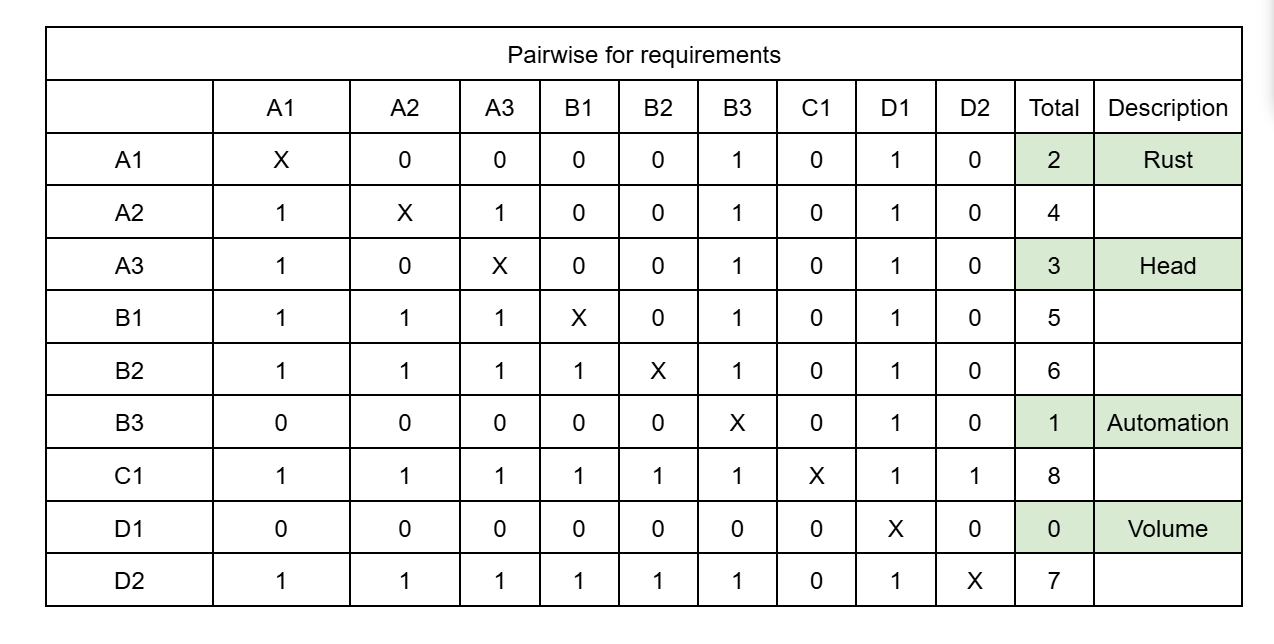
Application: To systematically converge on our final design scope, we utilized a Pairwise Comparison matrix to evaluate trade-offs. By objectively weighing factors like rust detection, head shape sorting, automation, and processing volume against one another, we mathematically identified which features delivered the highest value to the stakeholder.
Evaluation & Reflection
Effectiveness: Very High. This tool was critical for validating our design position. It allowed us to confidently descope lower-priority functions (like head-shape sorting) in favour of operational reliability and a compact footprint, matching my value of Efficiency.
Future Application: I will rely on Pairwise Matrices whenever a project scope threatens to expand beyond feasibility. It is an excellent best tool to mathematically justify omitting certain features to guarantee overall system success.
CTMF: Prototyping with Purpose (Represent)
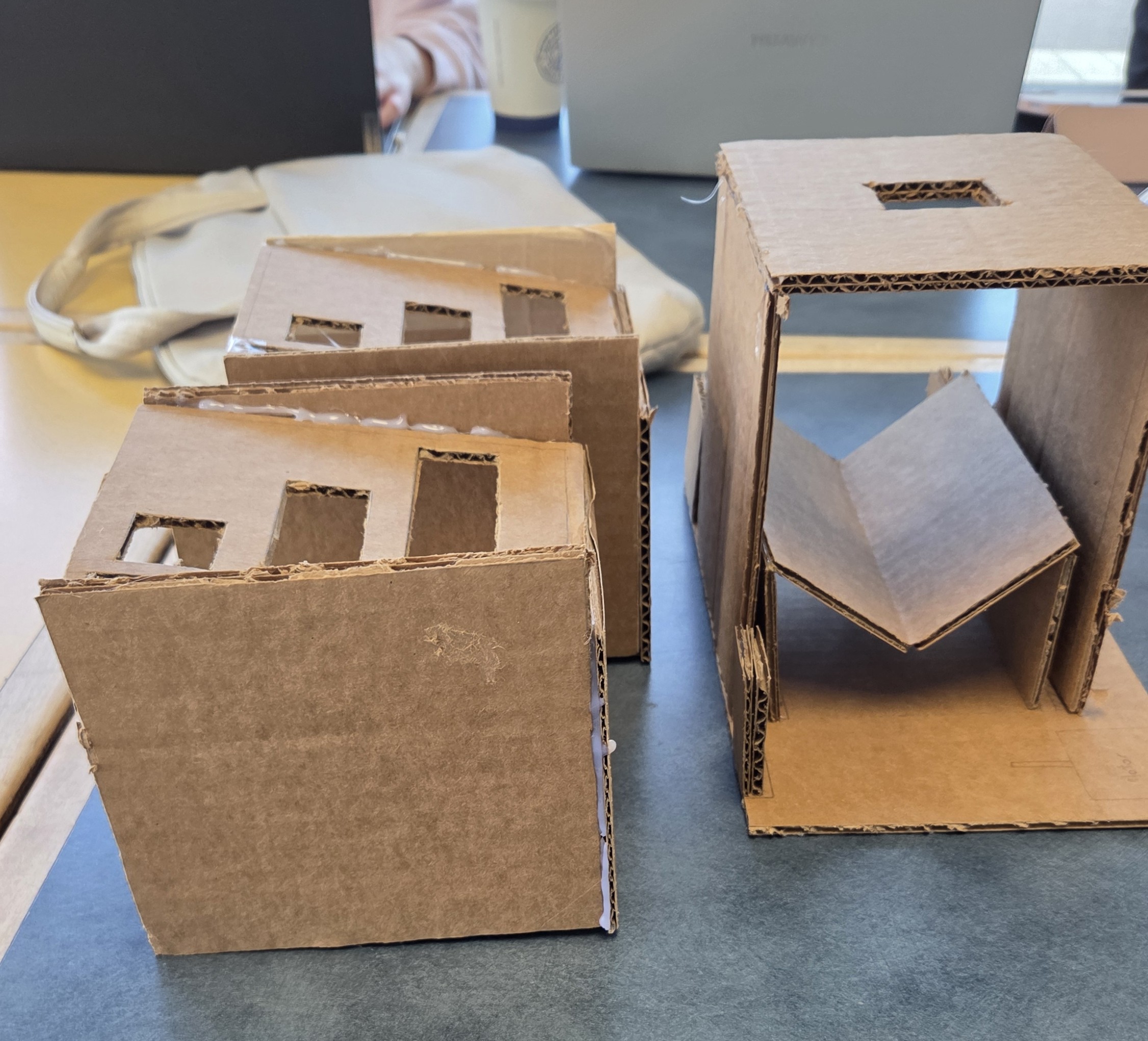
Application: Instead of building the entire machine at once, we isolated the Computer Vision tracking and represented it through a dedicated physical test. We ran fifty physical screws past the camera to train the model and prove the sorting logic empirically before integrating any complex motors or ramps.
Evaluation & Reflection
Effectiveness: Highly Effective. This isolated testing provided immediate, data-driven validation of our core technology. Attempting full-system integration without proving the CV logic first would be ineffective.
Future Application: I will isolate and prototype the highest-risk subsystems first. Failing on a single component and realizing the need for improvements is drastically more resource-efficient than doing so on a fully assembled machine.
In accordance with the UofT Code of Academic Behaviour, I explicitly acknowledge the contributions of my Praxis II teammates: Keira Kawada, Emma Luo, and Angela Jiao. This design was a product of collective iteration, rigorous debate, and shared prototyping efforts.
References
[1] Praxis II Engineering Design Studio. "GTA WoodWorks Showcase Documentation." University of Toronto, Winter 2026.